
Video preservation
What Should You Do With Unlabeled Home-Movie Tapes?
A simple first plan for mystery tapes: preserve clues, avoid unreliable playback tests and clarify assessment and transfer costs.
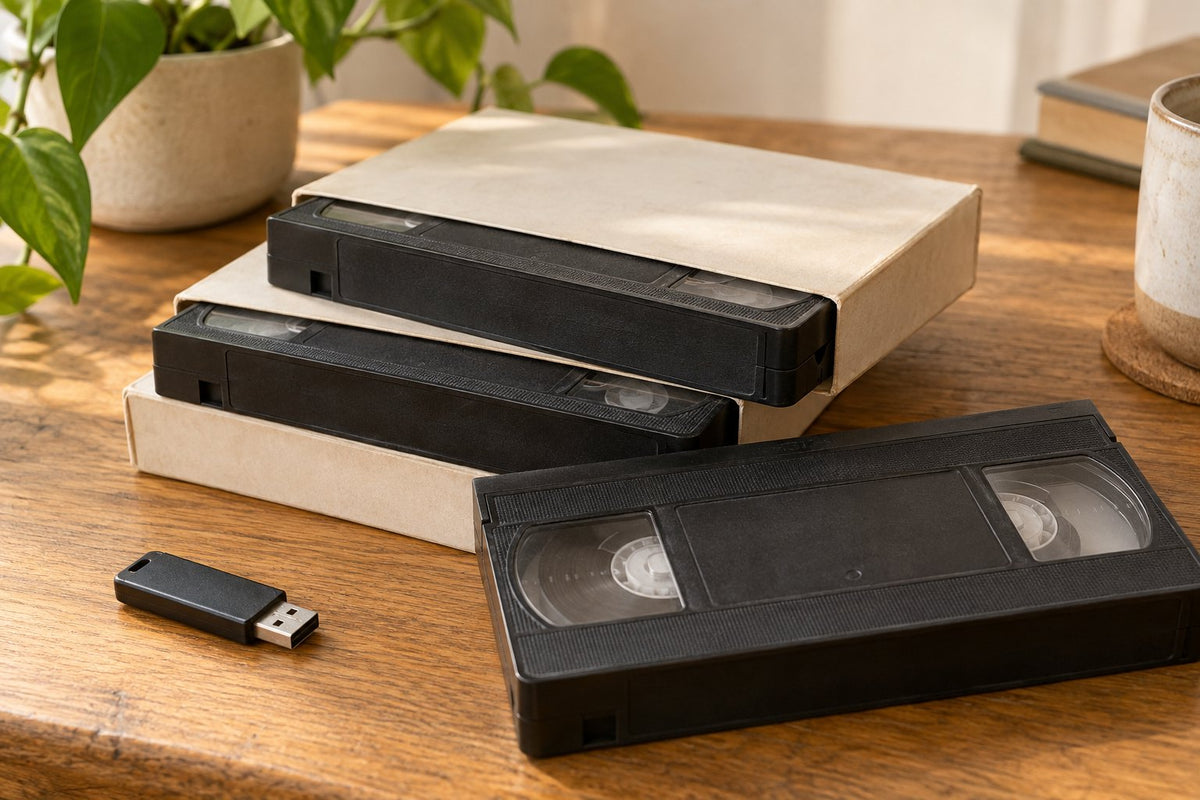
If you find unlabeled home-movie tapes, keep them together, give each one a temporary identifier on its case and ask about identification before discarding anything. An empty label does not mean an empty tape, and one failed playback does not prove there is no recording.
You do not need to watch every tape before contacting Family Media Transfer. Send a photo enquiry with the formats you recognize, an approximate count and any condition concerns. Confirm the assessment, transfer and blank-tape policies for your project before assuming a particular charge.
Make a simple record before moving the collection
Photograph each box as you found it, then keep cases, inserts and related items together. A date on a storage box or a note tucked into a case may be the only clue that ties several recordings to the same event.
Use removable organization around the media, such as numbered cases or a separate inventory, rather than placing material over cassette openings. A practical first inventory can have just four fields: your temporary ID, the format marking, any written clue and a condition note. Leave unknown details marked unknown.
Separate identification from viewing
Identifying a cassette format helps choose the playback equipment. Finding out what is recorded requires reading the recording. Those are separate tasks, and neither should be confused with a promise of free screening or a guaranteed successful transfer.
A clear photo can often narrow down the physical format, but similar shells may hold different recording systems. For example, an 8mm cassette may contain Video8, Hi8 or Digital8. The recording itself and any camera information help determine the correct playback setup.
What can I safely check at home?
- Read the visible format markings without opening the cassette.
- Keep handwritten notes and original cases with the media.
- Look for visible shell damage or tape outside the cassette.
- Record anything you already know about the camera, date or event.
- Tell the transfer service about mold or past playback problems before sending the tape.
Do not pull tape from the shell to inspect it, and do not try to make an unfamiliar cassette fit a player. If the tape is damaged, tangled or moldy, leave it as it is and ask for an assessment.
Should I buy a player to preview everything?
That depends on the size of the collection, equipment compatibility and whether you want to spend time doing the work yourself. A machine that powers on is not necessarily safe or suitable for the tapes you found. Before buying, identify the format and check actual playback support.
If you already tried one tape and got no picture, tell the team exactly what happened. A blank screen can reflect a playback problem; it is not a reliable inventory method for an unfamiliar collection.
What should I ask about pricing?
| Question | Why it matters |
|---|---|
| How is assessment or screening charged? | Identifying content can require work even before the final transfer scope is known. |
| What happens if a tape is blank or unreadable? | Policies differ; do not assume a full transfer charge or a free service. |
| Does recorded length affect the price? | A tape's printed capacity is not the same as its actual running time. |
| How are additional charges approved? | Repairs or extra transfer time can change the estimate. |
| How are files matched to originals? | Your temporary IDs can make the returned files easier to identify. |
For FMT VHS projects, the standard transfer covers up to two recorded hours; additional two-hour blocks count as additional transfers and are confirmed first. Our VHS pricing guide gives examples.
Start with a manageable group
If the collection is large, identify which box or time period matters most and discuss a first batch. Keep the rest in order while you decide what to do next. For inherited mixed media, the large-collections service is a useful starting point.
Bring your rough count to an estimate, or ask the team to help identify the next step. Uncertainty about what is on the tapes is a reason to ask questions, not a reason to throw them away.